

Choosing the Right Catering Stove Size: 2026 Guide
Table of Contents
- How to Choose the Right Catering Stove Size
- Commercial Gas Range Dimensions: Standard Sizes for UK Kitchens
- Catering Stove Burner Configuration: 4, 6 or 8 Burners?
- Gas Safety Regulations for Catering Equipment: What You Must Know
- Matching Stove Size to Your Kitchen Space and Output
- Common Mistakes When Choosing a Catering Stove Size
- Conclusion: Get the Right Catering Stove Size First Time
- Frequently Asked Questions
Last Updated: September 15, 2026
How to Choose the Right Catering Stove Size
Choosing the right catering stove size comes down to three numbers: your available footprint, your peak covers per service, and the output your menu demands. Get those wrong and you either cook in a bottleneck or pay for capacity you never fire up. This guide from HOME UK EXPRESS LTD walks through dimensions, burner configuration, and the gas safety rules that apply to commercial kitchens.
Most buyers start with the stove and try to fit the kitchen around it. That is backwards, and it is the single most expensive mistake in this category. A commercial range is not a domestic cooker scaled up; it is fixed plant with a gas supply, clearance requirements, and ventilation that has to be designed around it.
Below, we break the decision into five practical steps and flag where most buyers go wrong.
Commercial Gas Range Dimensions: Standard Sizes for UK Kitchens
Commercial gas range dimensions are standardised around a small number of footprint widths, which makes planning far easier than most buyers expect. The common widths sit in bands rather than exact figures, and manufacturers design units to slot into those bands so a kitchen can be reconfigured without rebuilding the whole line.
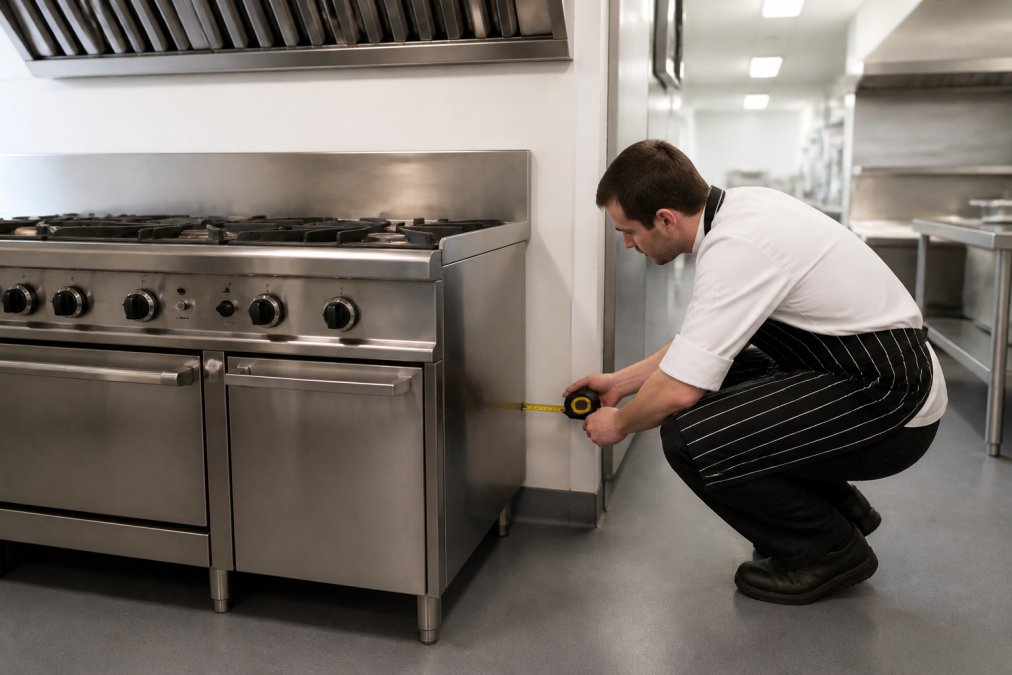
Depth matters as much as width. A range that fits the gap but leaves no service clearance behind it is a maintenance problem waiting to happen, and clearance requirements are set by the manufacturer and by the ventilation design, not by what looks tidy. Measure the gap, then subtract the clearance the installation manual specifies.
Height is the one dimension buyers consistently overlook. Cooking surfaces are designed to work with standard worktop heights so a range can sit in a line with prep benches. If your existing benches are a different height, the range becomes a trip hazard in a busy service.
Three practical checks before you commit:
- Measure the gap at floor level, not at worktop level; skirting and services often intrude
- Confirm the door swing and any fold-down shelves clear the walkway
- Check the gas connection point position, not just the unit footprint
Catering Stove Burner Configuration: 4, 6 or 8 Burners?
Catering stove burner configuration should follow your menu, not your budget. The right number of burners is the number that keeps every pan moving during your busiest service without a single ring sitting cold for the rest of the week.
A four-burner unit suits a small operation running a short menu: a café, a mobile unit at weekend events, or a kitchen where most cooking happens in one or two pans at a time. Six burners is the workhorse configuration for a restaurant running a mixed menu with several dishes on the go simultaneously. Eight burners and above suits high-volume operations, banquet work, and kitchens where a dedicated stock or sauce ring runs all day.
The mistake is buying burners as a proxy for power. A four-burner range with high-output burners will out-cook a six-burner unit with weak ones. Check the heat output per burner and the pan support spacing, because a wide pan that bridges two rings wastes both.
| Configuration | Best For | Watch Out For |
|---|---|---|
| 4 burners | Cafés, mobile units, short menus | Running out of rings at peak |
| 6 burners | Restaurants with mixed menus | Footprint creep in small kitchens |
| 8+ burners | Banqueting, high-volume service | Ventilation and gas supply load |
Gas Safety Regulations for Catering Equipment: What You Must Know
Gas safety regulations for catering equipment in commercial kitchens are enforced through the Gas Safety (Installation and Use) Regulations, and compliance is not optional. Any gas work in a commercial kitchen must be carried out by an engineer on the Gas Safe Register, and the responsible person for the premises carries the legal duty (Gas safety for employers).
The practical implications for a stove purchase are straightforward. Installation is a regulated activity, so budget for a registered engineer rather than treating it as a DIY job. Commercial catering establishments also need their gas appliances and flues inspected regularly, with records kept, and the frequency depends on the type of premises and the appliances installed. For the current requirements, check the Health and Safety Executive guidance on gas safety in catering and the Gas Safe Register's commercial catering information, which set out who may work on what.
Ventilation is part of the same picture. Extraction has to match the cooking load, and a larger range with more burners generates more heat, moisture, and combustion products. If you upgrade the stove without reviewing the extraction, you create a compliance problem and an uncomfortable kitchen.
Matching Stove Size to Your Kitchen Space and Output
Matching stove size to kitchen space means working from peak service backwards, not from the showroom floor forwards. Start with the maximum number of covers you serve in your busiest hour, then work out how many pans that puts on the heat at once.
A useful rule of thumb: count the dishes that need a burner at the same moment during peak, add one ring as headroom, and that is your minimum burner count. If your menu relies heavily on one large pan, a wider range with fewer, more powerful burners beats a narrow range packed with small ones.
Then check the space against the output. A small kitchen with a large range loses prep area, and prep area is where service speed is actually won. Many operators find that a slightly smaller range plus a separate high-output burner for the one dish that needs it gives better throughput than one oversized unit.
- Count simultaneous pans at peak, then add one
- Match heat output to your heaviest pan, not your average one
- Keep at least one clear prep surface next to the range
- Plan the gas supply and extraction before ordering
Common Mistakes When Choosing a Catering Stove Size
The most common mistake is buying for the menu you hope to run rather than the one you actually run. Capacity you never use still costs money to install, ventilate, and service.
Three more to watch:
- Ignoring clearance. A range that fits the gap but blocks service access fails inspection and frustrates every engineer who visits.
- Underestimating extraction. More burners mean more heat and moisture, and extraction that was adequate for the old unit often is not.
- Skipping the gas supply check. A larger range may need a supply capacity your existing pipework cannot deliver, which turns a simple swap into a building project.
The counterpoint matters too. Buying too small to save money is its own trap, because a range that cannot keep up at peak forces you to turn work away. The right size sits between those two failures, and it is decided by your peak service, not by the price tag.
Conclusion: Get the Right Catering Stove Size First Time
Getting the size right first time saves you the cost of a second installation, a second inspection, and a second round of disruption in a working kitchen. Measure the footprint, count the pans at peak, and confirm the gas and ventilation can carry the load before you buy.
At HOME UK EXPRESS LTD, we supply heavy-duty gas burners and professional catering stoves for both domestic and commercial kitchens, with competitive pricing and fast delivery.
Frequently Asked Questions
What are the standard dimensions for commercial catering stoves?
Most commercial gas ranges in the UK come in widths of 600mm, 900mm, 1200mm or 1500mm, with depths typically 700mm to 900mm and heights around 900mm. These dimensions allow them to fit standard kitchen modules. Always measure your available space, including clearance for ventilation and gas connections, before ordering. Check the manufacturer's specification for exact sizes, as they can vary slightly between models.
How do I calculate the required stove size for my kitchen output?
Start by counting your busiest service period's covers. A general rule is one burner per 10 to 15 covers for simple dishes. For example, 60 covers might need 4 to 6 burners. Also consider your menu: dishes requiring multiple pans or long simmering need more burner space. Factor in oven capacity if you rely on roasts or baked items. It's better to oversize slightly than to run out of cooking space during peak times.
Do I need a 4-burner or 6-burner catering stove for my business?
The choice depends on your menu and volume. A 4-burner stove suits small cafés or mobile caterers with limited menus, while a 6-burner is better for busy restaurants or events with multiple dishes. If you often use large stock pots, a 6-burner gives more flexibility. Remember that burner configuration also affects layout: some stoves have wider spacing for large pans. Assess your typical cooking load and available space to decide.
What safety regulations apply to commercial gas stove installation?
In the UK, all commercial gas work must be carried out by a Gas Safe registered engineer, as required by the Gas Safety (Installation and Use) Regulations 1998. You must also ensure adequate ventilation and comply with the Provision and Use of Work Equipment Regulations 1998 (PUWER) for maintenance. Regular gas safety checks are mandatory for commercial premises. Always ask for the engineer's Gas Safe ID card and keep records of inspections.
How much clearance space is required around a commercial catering stove?
Clearance requirements vary by manufacturer, but typically you need at least 150mm at the sides and back for ventilation and gas connections. If the stove is next to a combustible surface, you may need a heat shield or greater clearance. Always check the installation manual and British Standards (BS 6173 for gas catering appliances) for specific guidance. Allow extra space for easy cleaning and maintenance access.